It had been more than two decades since the American Bus Association (ABA) last addressed the United States Senate Subcommittee on Transportation. That changed this year, when the association stepped into the national spotlight once again – reinvigorated to redefine the future of mobility. Presenting the motorcoach industry’s top five safety priorities, ABA’s appearance before lawmakers was more than procedural. It was symbolic: a clear declaration that the group travel industry is not only relevant, but vital to the nation’s transport and tourism narrative.
That moment on Capitol Hill is emblematic of a broader renaissance within the ABA. Under new leadership and armed with a sharpened strategic agenda, the association has transformed from a well-respected legacy institution into a forward-leaning engine of modernization, advocacy, and opportunity. As ABA approaches its 100th anniversary in 2026, it is not merely preserving its history; it is actively reshaping the future of North American group travel.
A Reimagined Strategic Core
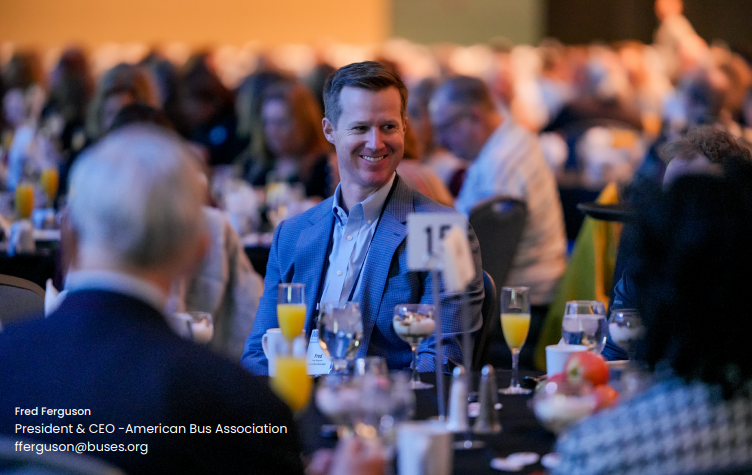
When Terry Fischer, ABA Board Chair and President of TCS, hired Fred Ferguson as Chief Executive Officer in July 2024, he set in motion a wave of positive change grounded in his vision for the association’s future. Following a 25-year leadership legacy, the potential for resistance was high, but Fischer’s decisive leadership and Ferguson’s fresh perspective ignited renewal. One of the first major milestones under Ferguson’s tenure was the introduction of a rolling three-year strategic plan – the association’s first in over six years. More than a static document, this plan has become a dynamic operating framework that aligns board and staff under four clear pillars: Advocacy, Safety & Operations, Workforce & Culture, and Marketplace.
Each of these pillars is a commitment, not a category – brought to life through the partnership of Fischer and Ferguson’s strategic vision, consensus building and execution. Advocacy now encompasses an expanded presence on Capitol Hill, where ABA’s policy voice is once again being heard in meaningful, high-stakes conversations. Safety & Operations are being redefined through the evolution of the Bus Industry Safety Council (BISC), which is poised to launch credentialled educational programs to elevate training and compliance across the industry. Workforce & Culture are anchored by the Driving Force Council’s response to talent shortages and shifting labor needs, while Marketplace continues to evolve as one of the most high-impact commercial convenings in the North American travel and transportation sector.
Culture as Catalyst
Change in strategy is only as effective as the culture that carries it. At ABA, that culture is defined by empathy, action, and a relentless commitment to members. It is this “member-first” mindset that has made the difference, not just as a slogan, but as a shared behavioral standard across the organization. Staff are encouraged to operate with urgency, to lead with understanding, and to think like the operators and travel professionals they serve.
Recruitment has followed suit. The ABA team is now composed of individuals who are as comfortable in high-level strategic discussions as they are in the granular execution of initiatives. Vision matters, but so does delivery. In this environment, success is measured not only by ideas generated, but by value created. That value is most visible in the feedback from members who now experience ABA not as a distant bureaucracy, but as a responsive partner committed to their business growth and professional development.
Proof Points in a Reinvigorated Narrative
This cultural and strategic alignment produces results that are both measurable and meaningful. ABA Marketplace 2025 became the most successful iteration in the association’s history, generating record numbers in revenue, appointments, and attendee satisfaction. Its position as the premier B2B event for the North American group travel and tourism sectors is not only intact; it is fortified.
Content production, long a dormant area, has accelerated dramatically. In 2025 alone, ABA published more stories than in the entire previous year – a staggering 288 per cent increase from 2023. This surge in communication is not about volume for its own sake, but about reasserting ABA’s role as a thought leader and agenda-setter in the travel and ground transport space. The association is no longer reacting to narratives; it is shaping them.
Perhaps most telling of all was that return to Capitol Hill. In a single appearance, ABA re-established its voice in the corridors of power, advancing a practical and data-driven safety agenda that speaks to its credibility, professionalism, and readiness to lead.
A Centenary in Sight
With its centennial celebration on the horizon, ABA is undertaking a modernization effort as ambitious as it is intentional. A new brand identity is under development – one that acknowledges the association’s long-standing influence in transportation while reflecting its contemporary role as a connector, collaborator, and convener of impact. This is not a cosmetic exercise. The new brand is part of a wider transformation that includes a redesigned digital presence, soon to be unveiled through a fully rebuilt website that meets the expectations of today’s members while positioning ABA as a best-in-class membership organization.
Simultaneously, the association is scaling its policy advocacy, expanding credentialled learning pathways, and investing in workforce development at a time when talent is both scarce and essential. These are not optional enhancements; they are structural investments in the longterm sustainability of the group travel industry.
Looking outward, ABA is extending an invitation: to members, to policymakers, to emerging professionals. It is an invitation to participate in a future where group travel is not simply sustained, but strategically elevated, supported by stronger safety frameworks, smarter workforce solutions, and deeper industry collaboration. It is a future in which connection remains the guiding principle, and collective progress the enduring goal.
The story of the American Bus Association is not one of sudden reinvention, but of steady, deliberate evolution. In an industry defined by movement, ABA has proven that progress is not measured merely by distance travelled, but by the clarity of direction and the strength of the engine behind it.
Today, as travel ecosystems continue to recalibrate in the wake of disruption, ABA stands not only as a representative body but as an architect of what comes next. Its renewed voice on Capitol Hill and its relentless member-first approach all points to an organization that has reclaimed its seat at the center of the travel and transportation dialogue.
Looking ahead to its centenary, ABA is charting more than a celebratory milestone. It defines a future where group travel is not only sustained, but strategically elevated, supported by smarter policy, safer systems, and a stronger, more unified workforce. The path forward has rarely looked more promising.