
Ofland Escalante: A Different Way to Stay Close to the Wild
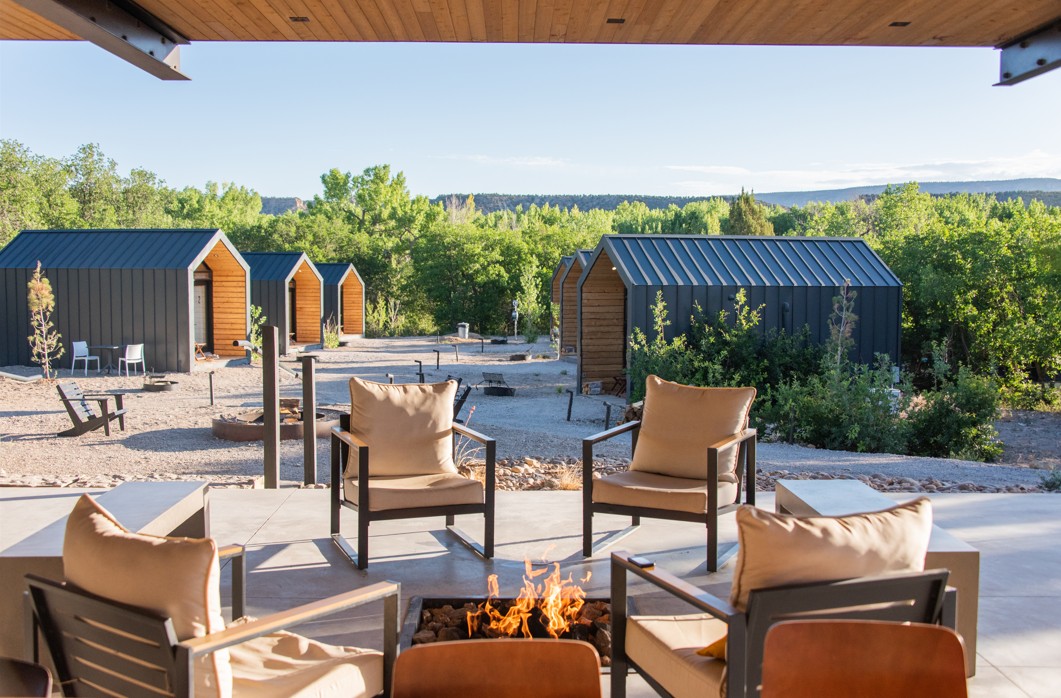
The road into Escalante does not announce itself in any dramatic way. It unfolds slowly, through long stretches of desert that feel at once exposed and expansive, where the landscape seems to operate on a different sense of time. There are no sharp transitions, only a gradual deepening of colour and scale. Along Utah’s Scenic Byway 12, the land does most of the work, drawing the eye outward rather than inward. It is within this setting that Ofland Escalante sits, not as a focal point, but as part of the rhythm of the place, easy to miss at first glance and all the more deliberate for it.
That restraint is telling. In a category increasingly shaped by design statements and curated experiences, Ofland Escalante feels less like something imposed and more like something positioned. The property does not attempt to compete with its surroundings. Instead, it operates with a quieter logic, one that treats the landscape as the primary experience and everything else as a means of entering it. In doing so, it points towards a different way of thinking about outdoor hospitality, one where the role of a hotel is not to dominate attention, but to frame it.
The pull of the landscape
The American Southwest has long carried a particular kind of appeal. Its scale resists easy comprehension, and its beauty is not ornamental but elemental. Slot canyons narrow into shadow, waterfalls appear without warning, and vast stretches of open land create a sense of distance that is difficult to replicate elsewhere. For many travellers, the draw is not simply visual, but emotional. It offers a form of separation, a chance to step outside the pace and density of everyday life.
As interest in these environments has grown, so too has the infrastructure built around them. Outdoor hospitality has expanded quickly, responding to demand with new formats that promise immersion without sacrificing comfort. Yet this growth has introduced its own tensions. The more the experience is designed, the greater the risk that it begins to feel detached from the landscape it seeks to celebrate. In some cases, the setting becomes a backdrop rather than the central presence.
Escalante sits at a point where that balance still feels intact. The surrounding land remains the defining feature, shaping how visitors move, what they notice, and how they spend their time. Any property in this environment faces a simple question: how to exist within that context without disrupting it.
Design as restraint
Ofland Escalante answers that question with a form of discipline that is not always immediately visible. The accommodation choices reflect a careful reading of place. Light-filled Tiny Cabins, reimagined vintage Airstreams, and larger Deluxe Cabins are arranged in a way that feels considered rather than arranged for effect. Each option offers a different level of comfort, but none attempts to dominate the setting.
There is a consistency in how these spaces are approached. Materials, scale, and layout are used to echo the surrounding environment rather than contrast it. Even the more refined elements, such as spa-quality bathhouses or well-equipped interiors, are integrated in a way that feels supportive rather than attention-seeking. The design does not ask to be admired. It simply works, allowing the landscape to remain the primary point of reference.
This approach extends beyond the physical structure of the property. The overall experience is shaped by what has been included and, just as importantly, what has been left out. There is no sense of over-programming. Guests are given enough to engage with, but not so much that their time becomes directed or managed. The result is a form of hospitality that feels open rather than orchestrated.
The experience of staying
Time at Ofland Escalante tends to unfold in small, deliberate moments. Mornings begin quietly, with light moving across the desert and the sense that there is no immediate need to fill the day. Some guests head out early, setting off towards nearby trails, slot canyons, or national parks. Others stay closer, allowing the pace of the place to shape their plans.
By late afternoon, the rhythm shifts. A ready-to-cook meal might be prepared over a campfire, the process as much a part of the experience as the food itself. The drive-in theatre comes to life as evening approaches, with guests watching films from the seats of vintage cars, a detail that feels both nostalgic and fitting in a landscape defined by open space. Later still, the oversized hot tub offers a different perspective, set beneath one of the darkest skies in the country, where the absence of artificial light reveals a clarity that is increasingly rare.
These elements are distinct, but they are not presented as highlights to be ticked off. They exist as options, shaping the texture of a stay without defining it. What lingers is not any single feature, but the overall sense of ease. The property provides enough structure to support the experience, while leaving space for the landscape to assert itself.
Scaling without losing character
Looking ahead, the question is whether this approach can be carried into new locations without losing its clarity. Plans to expand, with sites near Zion National Park and Great Smoky Mountains National Park, suggest confidence in the model. Yet they also introduce a familiar challenge. Growth in outdoor hospitality often brings pressure to standardise, to translate what works in one setting into a repeatable formula.
For Ofland Escalante, the strength of the concept lies precisely in its responsiveness to place. Replicating that requires more than copying a format. It demands the same level of attention to landscape, the same willingness to adapt, and the same restraint in design and programming. If that discipline holds, expansion becomes less about scaling a product and more about interpreting different environments with a consistent philosophy.
That distinction may prove increasingly important. As more travellers seek out nature-based experiences, the success of the sector will depend not only on access, but on how thoughtfully that access is managed. Ofland Escalante offers a reminder that the most effective approach is often the least intrusive. In a landscape that already provides more than enough, the role of hospitality may simply be to step back, and allow it to be seen.