
A Private Kingdom on the River Bann
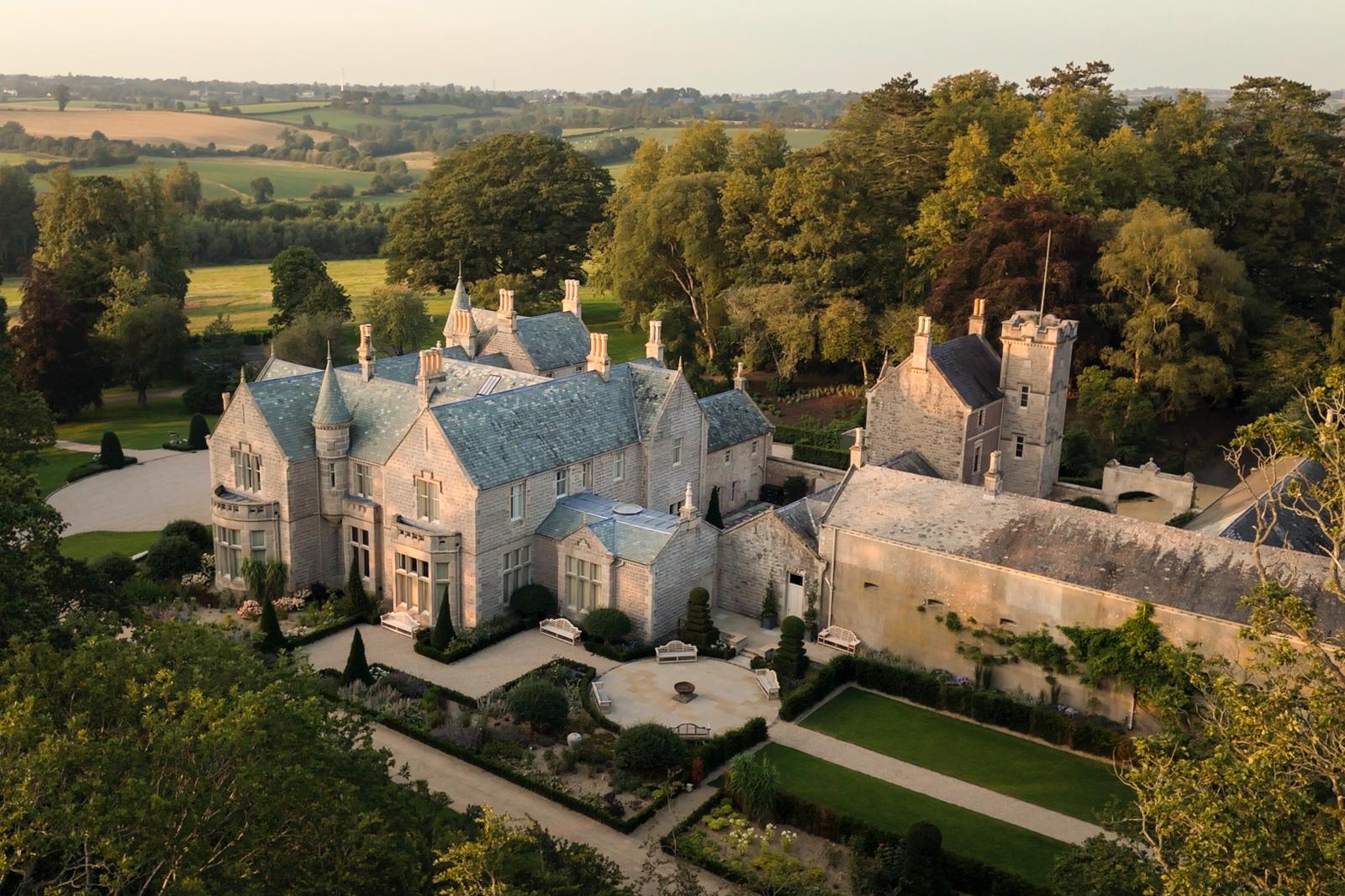
Some of the most expensive things in hospitality are things that are not there. No queue at reception. No stranger at the next table. No second wedding drifting through the corridor. No need to negotiate the swimming pool, the garden or breakfast with anybody who was not invited. Luxury has spent decades proving itself through abundance, yet the value of absence has become harder to ignore. Northern Ireland’s own tourism strategy increasingly describes high-end travel through privacy, exclusivity, personalisation and meaningful connection with place rather than mass opulence. The calculation becomes particularly interesting when 207 acres of parkland, woodland and riverbank are set aside for the occupants of just ten bedrooms.
That is effectively the proposition at Gilford Castle Estate. The Victorian Scottish Baronial house, restored following an investment of more than £20 million by owners Robert and Adrienne Moffett, the County Monaghan couple whose vision has shaped the estate’s revival, is offered only on an exclusive-use basis, whether for a wedding, private celebration, corporate retreat or several days in which very little needs to happen at all. Guests do not simply reserve rooms inside somebody else’s hospitality operation; for the duration of the stay, the castle and estate become theirs to inhabit. Fishing, falconry, private dining and time on the River Bann can all be arranged, but none is obliged to justify the booking. Gilford’s motto, Time Well Spent, begins to sound less like hospitality copy when considered against the thing the estate is really rationing: not space, but interruption.
A House, Not a Hotel
The distinction matters because Gilford began life as precisely that: a private home. Its restoration had to solve a problem familiar to many heritage properties entering hospitality. Open the doors too widely and domestic character can disappear beneath the operational language of bedrooms, covers, capacities and events. Preserve the house too reverently and it risks becoming somewhere admired rather than somewhere lived in.
That distinction appears to have guided much of Robert and Adrienne Moffett’s restoration. Their ambition was not simply to return a listed house to architectural order, but to preserve enough of its domestic character for people to inhabit rather than merely admire it. The reception rooms remain places in which guests are expected to sit, eat, talk and linger; the ten bedrooms are individually appointed rather than reproduced from a house style. Period architecture and decorative character have been conserved, but modern comfort has been inserted without requiring the building to forget what it was. The result depends on a curious balancing act: giving paying guests the standards of a serious luxury property while allowing them to feel, for a few days, as though the word property is slightly too commercial for what they have borrowed.
Exclusive use makes that illusion possible. A hotel retains control of its rhythm even when it delivers exceptional service. Breakfast runs somewhere between two times; common spaces remain common; the building belongs, socially at least, to everybody staying in it. Gilford reverses some of that relationship. Once a party arrives, privacy is not an upgrade purchased around the edges of the stay. It is the organising principle.
The Right to Waste an Afternoon
What somebody does with that privacy is another matter. Luxury travel can become surprisingly industrious. There are restaurants to secure, experiences to book, treatments to schedule and enough “once-in-a-lifetime” opportunities to make an afternoon without an appointment feel faintly irresponsible. A carefully curated escape can begin to resemble the diary one travelled to escape.
Gilford has plenty with which to fill it. The river invites fishing and kayaking; the estate can arrange falconry and other pursuits; ornamental gardens, mature woodland and parkland offer the softer possibility of simply wandering until nobody quite remembers what time lunch was supposed to begin. The important thing is not the inventory of activities. It is the guest’s right to decline them.
That gives Time Well Spent a more interesting meaning. Time does not become valuable merely because every hour has been optimised. Sometimes value lies in recovering authority over it. A wedding party may want two days organised almost to the minute; a family may want dinner and very little else; a corporate group may need enough structure to make a retreat useful without creating the peculiar experience of leaving work to attend more meetings somewhere prettier.
Gilford’s task is therefore less about filling time than understanding what a particular group wants time to feel like.
Knowing When to Disappear
That makes personalisation considerably harder than adding a guest’s name to a welcome card. The estate describes its approach as having an “enquiring mind”: understanding why somebody has chosen Gilford, what success looks like for the occasion and which emotional details may matter more than the obvious logistical ones. The objective is to anticipate expectation before attempting to exceed it.
There is a useful paradox in high-end service. The amount of work required behind the scenes tends to increase as the effort visible to the guest decreases. Excellent hospitality can involve knowing when somebody needs attention, but also recognising when attention itself would become an interruption. White-glove service works best when the glove is not constantly waving for recognition.
Food provides a smaller expression of the same philosophy. Dining draws on local produce alongside herbs, eggs and honey from the estate itself. Livestock remain part of the parkland, while investment in habitats and renewable energy places the castle within a working landscape rather than reducing 207 acres to scenery. That matters because authenticity is difficult to manufacture after the fact. Gilford’s setting is not a backdrop added to the hospitality product; the hospitality product has been inserted into a place that was already alive.
Growing Without Filling the Castle
The harder question arrives now that the restoration is complete. For Robert and Adrienne Moffett, the £20 million-plus restoration has brought one ambition to fruition while opening another: Gilford intends to broaden its accommodation and experiences, bringing more commercial life to an estate whose appeal partly rests on how few people occupy it at once. Growth is therefore not simply a question of adding capacity. It is a question of how much can be added before exclusivity begins to lose definition.
The appointment of Tim Husbands MBE as the estate’s first chief executive in 2026 gives that next phase considerable operational weight. Husbands previously led Titanic Belfast from inception through its development into a major international attraction, and joins Gilford following the restoration programme of more than £20 million. His challenge here is almost the inverse of mass attraction management: building a significant destination whose value depends on ensuring that, at the point of experience, it never feels particularly busy.
That may be the most revealing tension in Gilford’s future. Hospitality businesses usually grow by selling more nights, seats, rooms and experiences. A private estate built around exclusivity has to become more capable without becoming more crowded, and more commercially ambitious without allowing ambition to intrude on the guest.
The castle has already spent more than £20 million restoring something built to survive generations. Its more delicate business now concerns something nobody can restore once it has passed. Gilford may ultimately be judged not by how completely it fills the estate, but by how completely it allows its guests to possess their own time while they are there.